
Montana MVD Permit Practice Test 23
- Questions33
- Correct to pass27
- Passing score82%
- Minimum age14 years 6 months
-
1. A stop line is painted across the pavement at this sign. Where must the vehicle come to rest?

Show answer
Answer A: Behind the stop line, with no part of the vehicle across it
The vehicle must halt behind the stop line; where no line is painted the driver stops before the crosswalk, and where there is neither, before entering the intersection.
-
2. Why should the washer reservoir hold proper washer fluid rather than plain water in winter?
Show answer
Answer D: Water freezes and it leaves you with no way at all to clean the glass
Washer fluid contains antifreeze, so it still works in the cold, whereas water freezes in the reservoir and the lines.
-
3. Where should your hands normally rest on the steering wheel?
Show answer
Answer C: On opposite sides of the wheel, near the 9 and 3 positions
Hands placed opposite each other near the middle of the wheel give smooth, balanced control and keep the arms clear of a deploying air bag.
-
4. A curb sign reads 2 Hour Parking, 8 AM to 6 PM, Monday to Saturday. When may you stay longer than two hours?
Show answer
Answer A: Outside those hours and on Sundays
A time limit applies only during the days and hours printed on the sign; outside them the ordinary parking rules apply.
-
5. Why is the road often most slippery during the first few minutes of rain after a long dry spell?
Show answer
Answer C: Oil and dust on the surface mix with the water into a slick film
Oil drippings and road dust build up on dry pavement, and the first light rain lifts them into a slippery film before heavier rain washes it away.
-
6. A flashing red lamp is mounted above a stop sign at a rural intersection. What does it add?
Show answer
Answer C: Emphasis, while the required stop stays the same
A stop beacon makes an easily missed stop sign more visible, but it neither adds to nor takes away from the obligation the sign already imposes.
-
7. A flagger turns the paddle to the orange face reading SLOW. What does that tell approaching drivers?
Show answer
Answer D: Reduce speed and continue through the work area with care
The SLOW face keeps traffic moving at a reduced speed while workers or equipment are close to the travel lanes.
-
8. The lights at a highway-rail grade crossing begin to flash red as you approach. What must you do?
Show answer
Answer B: Stop short of the tracks and wait until the lights stop and no train is near
Flashing red lights at a crossing require a stop clear of the tracks, and you may proceed only once the lights have stopped, any gates are fully raised and no train is approaching.
-
9. A sign on a freeway restricts trucks to the two right-hand lanes. What should a car driver expect in those lanes?
Show answer
Answer A: More heavy vehicles and slower changes of speed
A truck lane restriction concentrates heavy vehicles on the right, and those vehicles accelerate, brake and change lanes far more slowly than cars.
-
10. What speed governs when a temporary limit has been posted at a Montana incident scene?
Show answer
Answer D: The temporary posted speed limit
Montana requires the driver to reduce speed to the temporary posted speed limit, and applies the fixed reductions only when no temporary limit is posted.
-
11. A school sign combined with an AHEAD plaque, or with a plaque giving a distance in feet, forms an assembly that
Show answer
Answer B: warns of a school crossing located further along the road
The school advance crossing assembly is placed before the crosswalk to give drivers notice, while a different assembly marks the crossing itself.
-
12. A sign warns that your exit leaves from the left side of the freeway. What should you do?
Show answer
Answer D: Move into the left lane in good time before you reach the exit
Left-hand exits are unusual, which is exactly why they are signed well in advance and why the lane changes should be finished early.
-
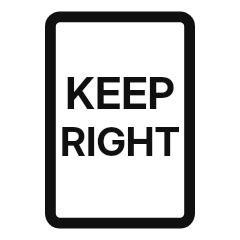
13. A driver ignores this sign and passes on the opposite side. What is the main risk?
Show answer
Answer B: Ending up on the wrong side of a divider, facing traffic coming the other way
The sign settles which side of a fixed divider is the legal one, so taking the other side sends the vehicle into the opposing stream or straight at the obstruction.
-
14. Traffic is heavy and a truck is stopped in the lane on your right. How do you keep an out?
Show answer
Answer B: Keep space open ahead of you and avoid being boxed in on both sides at once
Being hemmed in on both sides with no gap ahead removes every option, so keep at least one direction open.
-
15. At an intersection the signal flashes red toward you and flashes yellow toward the cross street. Who must yield?
Show answer
Answer D: You must, because the flashing red faces your road
A flashing red means stop and yield like a stop sign, while a flashing yellow lets the other road proceed with caution.
-
16. What is the usual result of driving well above the flow of traffic on a typical trip?
Show answer
Answer B: Very little time saved, with much greater risk
Signals, traffic and short distances swallow the theoretical gain, while crash risk and crash severity both climb sharply with speed.
-
17. When are the hazard warning lights properly used?
Show answer
Answer A: When your vehicle is stopped or barely moving and is a hazard
Hazard lights warn that your vehicle is an obstruction; they do not authorize illegal parking and they hide your turn signals while driving.
-
18. You are stopped in slow traffic and a motorcycle comes up between the lanes. What should you do?
Show answer
Answer D: Hold your position and avoid any sudden lane change
The danger to a rider between lanes comes from a vehicle moving sideways without warning, so staying predictable is what protects them.
-
19. You come up behind a bicyclist who is descending a steep hill in the middle of the traffic lane. What should you take into account?
Show answer
Answer D: The rider may be moving at close to the speed of the traffic
A bicycle can reach the speed of traffic on a descent, so there is little to gain from a pass and the rider needs the whole lane to steer around surface hazards.
-
20. You are passing a tractor-trailer on a wet freeway and its wheels throw heavy spray. What is the best technique?
Show answer
Answer B: Increase your wipers and pass steadily without hesitating
Spray blinds you for as long as you stay beside the truck, so prepare the wipers first and then spend as little time in the spray as possible.
-
21. A United States numbered route is normally marked with
Show answer
Answer C: black numerals on a white shield
The U.S. route marker is a white shield carrying black numerals, which sets it apart at a glance from the red, white and blue Interstate shield.
-
22. At an intersection where turning right on red is permitted and no sign prohibits it, what must you do before turning?
Show answer
Answer A: Come to a complete stop and yield to pedestrians and cross traffic
A right turn on red is allowed only after a full stop, and the turning driver must yield to pedestrians in the crosswalk and to traffic already using the intersection.
-
23. A yellow lamp flashes above a warning sign at a sharp curve. What does it ask of a driver?
Show answer
Answer D: Slow down and pass the point with extra care
A warning beacon draws attention to the sign it is mounted with, and the message of the sign is what the driver must act on.
-
24. Why is dusk one of the harder times of day to drive?
Show answer
Answer B: The failing light blurs shapes into the background
In fading light there is not enough contrast to pick objects out, yet it is not dark enough for headlights to do the work, so pedestrians and cyclists disappear.
-
25. You have to leave a trailer parked on a slope. What extra step protects it?
Show answer
Answer D: Chock the trailer wheels as well as setting the brake
Chocks physically block the wheels, which is the only thing that still holds if a brake or a coupling lets go.
-
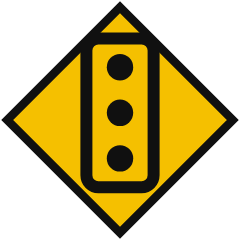
26. A driver passes this sign and the signal beyond it is already showing green. What is the safest response?
Show answer
Answer C: Ease off the accelerator and be ready to stop, because an indication that has been showing for a while is about to change
A signal that has been displaying the same indication for some time is close to changing, so arriving at a controlled speed with the brake covered is safer than accelerating to beat it.
-
27. An oncoming vehicle at night has its high beams on and you are being dazzled. Where should you look?
Show answer
Answer A: Toward the right edge of your lane
Looking toward the right edge line keeps you on course while sparing your eyes the worst of the glare. Slow down and do not retaliate with your own high beams.
-
28. What is the speed limit on a Montana interstate highway inside an urbanized area of 50,000 or more people?
Show answer
Answer B: 65 miles an hour
Montana sets 65 miles an hour at all times on interstate segments located within an urbanized area of 50,000 or more people.
-
29. When may you stop on the shoulder of a freeway?
Show answer
Answer A: Only in an emergency, moving completely off the travel lanes and switching on your hazard lights
The freeway shoulder is reserved for emergencies and for disabled vehicles, and a vehicle stopped there must be clear of the travel lanes with hazard lights on.
-
30. A deer has just crossed in front of you on a stretch signed for animal crossings. What is the best assumption?
Show answer
Answer B: More animals are likely to follow the first one
Deer travel in groups, so one animal crossing usually means others are about to follow, and a driver should slow and keep scanning both shoulders.
-
31. A driver ahead brakes for no reason you can see, again and again. What should you do?
Show answer
Answer B: Increase your following distance and be ready for yet another stop
Unexplained braking tells you the driver is unsure or distracted, so the safe answer is more room, not less.
-
32. You and the driver facing you both have stop signs at a two-way stop. You are going straight and that driver is turning left. Who has the right of way?
Show answer
Answer B: You do, and the turning driver must wait
Between two opposing drivers who both stopped, the one going straight goes first and the left-turning driver yields.
-
33. You have loaded the trunk heavily. Why might oncoming drivers flash their lights at you at night?
Show answer
Answer D: The rear sits lower, so your headlights point higher and dazzle them
Weight in the back tips the vehicle nose up and lifts the beam pattern, so low beams shine into the eyes of drivers coming the other way.