
Montana MVD Permit Practice Test 37
- Questions33
- Correct to pass27
- Passing score82%
- Minimum age14 years 6 months
-
1. You turn the wheel but the front of the vehicle keeps sliding straight ahead on a slippery road. What should you do?
Show answer
Answer C: Ease off the accelerator and reduce the steering angle until the front tires grip again
A front-wheel skid means the tires are asking for more grip than the surface can give. Less speed and less steering angle let them regain traction.
-
2. What is a designated driver?
Show answer
Answer A: Someone who agrees to drink nothing at all
A designated driver drinks no alcohol whatsoever, because any amount begins to affect judgment and the whole point is a sober driver.
-
3. What jail term and fine does Montana set for a first DUI conviction with no minor in the vehicle?
Show answer
Answer D: 24 consecutive hours to 6 months, and $600 to $1,000
A first Montana DUI carries 24 consecutive hours to 6 months of imprisonment and a fine of $600 to $1,000; the figures rise when a minor was in the vehicle.
-
4. You have fitted the small temporary spare tire after a flat. What should you keep in mind?
Show answer
Answer C: It is meant for low speed and short distances until the regular tire is repaired
Compact spares have limited grip, handling and durability. Follow the speed and distance limits printed on the tire and get the regular tire fixed soon.
-
5. An orange sign reads RIGHT LANE CLOSED AHEAD. What is the correct response?
Show answer
Answer A: Move left in good time and keep a steady pace
The sign is placed well before the taper so that drivers can merge smoothly rather than braking hard where the lane actually closes.
-
6. You are hosting a party and a guest who has been drinking wants to drive home. What should you do?
Show answer
Answer D: Stop serving and arrange a ride or a bed
Only time removes alcohol, so a host who wants to prevent a crash has to remove the driving, not try to speed up sobering that cannot be sped up.
-
7. Where is a road work ahead sign placed?
Show answer
Answer B: In advance of the work space or detour, so drivers are warned before reaching it
Advance warning signs are placed upstream of the work space or detour so that drivers have time to slow down and change lanes before reaching the activity.
-
8. You have driven at 70 mph for an hour and then exit onto a town street. What is the common risk?
Show answer
Answer B: Your sense of speed adapts, so 35 mph feels slow and you drive too fast
After a long stretch at high speed the brain adapts, so town speeds feel unnaturally slow; check the speedometer instead of trusting the feeling.
-
9. A farm implement ahead of you on a two-lane road is wider than its own lane. What should you do?
Show answer
Answer D: Hang back until you can see past it and pass only with a clear road
Wide equipment hides the road ahead and may extend farther across the center line than it appears, so the pass needs more room and a much better view.
-
10. Two drivers each have three drinks, one over three hours and one in half an hour. What is the difference?
Show answer
Answer C: The fast drinker reaches a higher peak level
The liver removes alcohol at a steady rate, so drinking faster than the body can clear it pushes the blood alcohol level much higher.
-
11. Your car has side curtain airbags. What should you avoid doing?
Show answer
Answer B: Resting your head against the window or the door pillar
A side airbag deploys from the pillar or roof rail, so a head leaning against that area is directly in its path.
-
12. Where does Montana require a driver to pull over for an approaching emergency vehicle using lights or siren?
Show answer
Answer B: Parallel to the right edge and clear of any intersection
Montana requires the driver to move to a position parallel to and as close as possible to the right-hand edge or curb, clear of an intersection, and to stay there until the emergency vehicle has passed.
-
13. At which location is this sign normally installed?
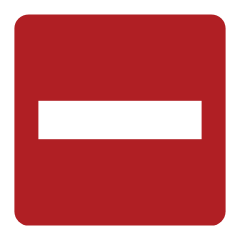
Show answer
Answer D: Facing traffic that could turn into a one-way roadway or ramp against the flow
It is posted where a driver could otherwise enter a ramp or a one-way roadway from the wrong end, so it faces exactly the traffic that has to be kept out.
-
14. You are entering a marked school zone during the posted hours. What should you do?
Show answer
Answer A: Slow to the school zone limit and watch for children
The school zone limit applies throughout the posted hours, whether or not you can see any children at that moment.
-
15. You are in the acceleration lane and the gap you were aiming for is now beside you. What is the best adjustment?
Show answer
Answer A: Change your speed a little to line up with a gap, then merge smoothly
The acceleration lane is for matching both the speed and the position of a gap, and small speed adjustments are what line the two up.
-
16. Why is repeatedly changing lanes to work through heavy traffic a poor idea?
Show answer
Answer A: It raises the crash risk and saves almost no time
Each lane change adds a conflict with another vehicle, and in congestion the lanes move at similar average speeds, so the gain is negligible.
-
17. Why is this restriction used so often on a divided road just before a crest or a bend?
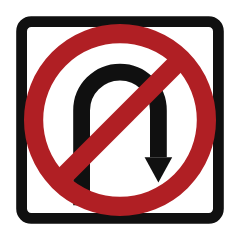
Show answer
Answer A: Because a vehicle turning across the median there stays hidden from approaching drivers until it is too late
The maneuver needs a long gap and good visibility, and where sight distance is short an approaching driver has no time to react to a vehicle turning across the road.
-
18. A small signal face beside a bikeway shows red, yellow and green lenses that each carry a bicycle symbol. Whom does it control?
Show answer
Answer C: Bicyclists using that crossing or bikeway
A bicycle signal face governs bicycle movements only, and people on foot at the same corner still follow the pedestrian signal.
-
19. Which vehicle is most affected by a strong side wind?
Show answer
Answer D: A van or a car towing a tall trailer
Wind pushes against the side area of a vehicle, so tall boxy shapes and trailers are moved far more than low heavy ones.
-
20. How must a child under two years old ride in a motor vehicle under Montana law?
Show answer
Answer A: In a rear-facing child safety restraint system
Montana requires a child under two years old to be properly restrained in a rear-facing child safety restraint system that complies with federal motor vehicle safety standards.
-
21. What is a microsleep?
Show answer
Answer D: A few seconds of sleep, sometimes with the eyes open
A microsleep is an involuntary lapse of a few seconds during which the driver is asleep and the vehicle travels blind, often without the driver knowing.
-
22. How is the yield sign shaped and colored?
Show answer
Answer C: A downward-pointing triangle with a wide red border and a red legend on white
The yield sign is a downward-pointing equilateral triangle with a wide red border and the legend in red on a white background, an outline used for no other message.
-
23. How far ahead should you normally be looking as you drive?
Show answer
Answer C: About 12 to 15 seconds ahead, well beyond the vehicle in front
Looking that far down the road lets you see a problem developing and slow smoothly, instead of discovering it in time only for hard braking.
-
24. What makes up the total distance needed to bring a vehicle to a stop?
Show answer
Answer A: The distance covered while you perceive the hazard, the distance covered while you react, and the braking distance
Total stopping distance combines the ground covered while you notice the hazard, the ground covered while you move your foot to the brake, and the ground covered while the brakes slow the vehicle.
-
25. Your lane is ending ahead in slow, heavy traffic and drivers in the next lane are already bumper to bumper. What is the recommended way to merge?
Show answer
Answer C: Take turns, one vehicle from each lane at the merge point
Alternating one for one at the merge point keeps both lanes moving and is the safest way to combine slow traffic.
-
26. You notice at night that one of your headlights has burned out. What should you do?
Show answer
Answer B: Get it replaced promptly, because other drivers may take you for a motorcycle
A single light makes your vehicle look narrower and further away, so other drivers misjudge you, and one light is also illegal.
-
27. Your phone is in a mount on the dashboard rather than in your hand. What is true?
Show answer
Answer B: It still takes your eyes and mind off the road
A mount solves the hand problem but not the eye or the mind problem, and reading or tapping a mounted screen costs the same seconds of attention.
-
28. You and an oncoming driver are both turning left at the same intersection. What is the usual rule?
Show answer
Answer D: Both turn in front of each other unless markings show otherwise
The normal practice is to pass driver side to driver side, turning in front of one another, unless pavement markings or signs direct a different path.
-
29. How does alcohol change the time a driver needs to respond to a hazard?
Show answer
Answer A: It slows it, so stopping takes longer
Alcohol is a depressant that lengthens the time between seeing a hazard and acting on it, which adds directly to the distance needed to stop.
-
30. A curb sign reads No Standing. What does it allow you to do?
Show answer
Answer B: Stop only long enough to pick up or drop off passengers
No Standing bars waiting for any purpose except the brief moment needed to let passengers in or out, which is stricter than No Parking.
-
31. You approach an intersection where the signal is flashing yellow. What should you do?
Show answer
Answer D: Slow down and cross the intersection with caution
A flashing yellow signal warns you to slow down and cross with care; it does not require a stop, but it does not give you priority either.
-
32. What is lane splitting?
Show answer
Answer B: A motorcycle riding between two lanes of traffic moving the same way
Lane splitting means riding along the line between two lanes of traffic going in the same direction rather than staying within a lane.
-
33. When is a child ready to use a vehicle seat belt without a booster seat?
Show answer
Answer A: When the lap belt lies across the upper thighs and the shoulder belt crosses the chest
Belt fit, not age, decides readiness. Until the child is tall enough for the lap belt to sit on the thighs and the shoulder belt on the chest, a booster is needed.