
Montana MVD Motorcycle Practice Test 23
- Questions33
- Correct to pass27
- Passing score82%
- Minimum age16 years
-
1. You are approaching an intersection in a line of traffic. What can you do to be more visible to a driver waiting to pull out?
Show answer
Answer D: Move to a lane position where you are not hidden behind the vehicle ahead
A motorcycle tucked directly behind a larger vehicle is invisible to a waiting driver until the moment it appears, so the rider moves to where the headlight can be seen.
-
2. What should a passenger be told about where to keep their legs?
Show answer
Answer D: To keep them away from the muffler, the chain and other moving parts
Exhaust pipes get hot enough to burn and exposed drive components can catch a loose leg, so the passenger must keep legs in and clear of them.
-
3. The driver ahead of you is straddling the lane line and is not signaling. How should you respond?
Show answer
Answer B: Stay back until you can see which lane that driver will take
A vehicle astride the line could move either way, so the only safe place is behind it where both possibilities are still covered.
-
4. At what alcohol concentration may a Montana driver aged 21 or older be arrested for driving under the influence?
Show answer
Answer D: 0.08 or more
Montana law makes it an offense to drive with an alcohol concentration of 0.08 or more, while the limit is 0.02 for drivers under 21 and 0.04 in a commercial vehicle.
-
5. You are making a U-turn at a signal on a green left arrow. Who must you still watch for?
Show answer
Answer D: People in the crosswalk you will cross as you come around
Even a protected arrow does not clear the crosswalk, and a U-turn sweeps across a crosswalk that pedestrians may already be using.
-
6. How does alcohol typically affect a driver's vision?
Show answer
Answer D: It blurs vision, weakens night vision and narrows attention to the sides
Alcohol slows the eye muscles and the brain's processing of what is seen, degrading focus, night vision, depth perception and awareness of movement at the edges of the field of view.
-
7. An oncoming driver flashes their headlights while you are waiting to turn left. What should you do?
Show answer
Answer D: Judge the situation yourself, since the flash may mean something else
A flash is not a legal signal and may mean many things, so the decision to turn stays yours and must be based on what you can see.
-
8. Traffic is heavy and you find yourself riding level with a car in the next lane. What is the problem with staying there?
Show answer
Answer B: You sit in the driver's blind spot, so a lane change could hit you
Motorcycles disappear easily in a blind spot, so adjust your speed to ride ahead of or behind the other vehicle instead of beside it.
-
9. A piece of farm machinery ahead of you is wider than its own lane. What should you do?
Show answer
Answer C: Hold back until you can see far enough to pass safely
Wide equipment leaves no gap inside the lane and may use part of the other side, so a pass needs a long clear view of the road ahead.
-
10. A turn restriction sign at the corner shows a range of times below the symbol. What does that mean?
Show answer
Answer A: The turn is banned only during the hours shown on the sign
Times posted under a regulatory symbol set the period during which the restriction applies; outside those hours the movement is permitted.
-
11. Why can a motorcycle ahead of you slow down without any warning light showing?
Show answer
Answer B: The rider may slow by downshifting or rolling off
Riders often lose speed by closing the throttle or changing down, which does not switch on the brake light, so watch the machine itself and keep back.
-
12. Fog thickens until you can barely make out the vehicle ahead. What is the safest action?
Show answer
Answer A: Slow right down and, if needed, leave the road at a safe place
In heavy fog the only safe speed may be very low, and if it drops below what the road allows, the answer is to pull well clear of the traffic lanes.
-
13. A large group has been divided into smaller groups. What should be done between them?
Show answer
Answer A: Leave a gap big enough for other vehicles to move in and pass safely
A gap between sub groups lets other traffic pass or merge without cutting into a formation, which keeps drivers from making sudden moves around the riders.
-
14. At an intersection that uses a lagging left turn, when is the left-turn arrow displayed?
Show answer
Answer B: After the through movement has run
A lagging left turn phase runs at the end of the green rather than the start, so a driver waiting to turn should not assume the arrow has been missed.
-
15. A driver ahead of you extends the left arm straight out horizontally through the window. What is being signaled?
Show answer
Answer C: A left turn
The left arm held straight out is the standard hand signal for a left turn.
-
16. A steady green arrow pointing left is displayed for your turning lane. What does it tell you?
Show answer
Answer D: The turn is protected because conflicting traffic is being held
A steady green arrow gives a protected movement in the direction shown, although you still yield to pedestrians and to any vehicle already inside the intersection.
-
17. A lane is marked with a large white bicycle symbol and chevrons, but there is no separate bicycle lane. What does it mean?
Show answer
Answer A: Bicyclists may use the whole lane, so follow or pass with care
A shared lane marking shows that bicyclists and drivers use the same lane and positions riders away from parked car doors, so passing means changing lanes.
-
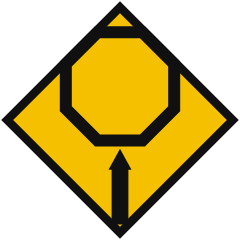
18. On a wet road, how should a driver adjust after passing this sign?
Show answer
Answer B: Start braking earlier, because a slippery surface lengthens the stopping distance
A wet surface lengthens stopping distance, so the extra warning distance should be spent braking gently and early instead of late and hard.
-
19. Which road feature is most likely to be slippery, particularly when wet?
Show answer
Answer D: Painted lane markings, manhole covers and steel plates
Paint and metal surfaces laid on top of the road offer far less grip than the pavement around them and become noticeably slick in the rain.
-
20. When are the hazard warning lights properly used?
Show answer
Answer A: When your vehicle is stopped or barely moving and is a hazard
Hazard lights warn that your vehicle is an obstruction; they do not authorize illegal parking and they hide your turn signals while driving.
-
21. How can you check that you are keeping a safe following distance?
Show answer
Answer A: Count at least three seconds between the vehicle ahead passing a fixed object and your reaching it
Pick a fixed roadside object, start counting when the vehicle ahead passes it and make sure at least three seconds elapse before you reach it, adding more time in poor conditions.
-
22. On an unlit road, about how far ahead do high beams normally let you see?
Show answer
Answer D: About 350 to 500 feet ahead of the vehicle
High beams light roughly 350 to 500 feet of road and low beams far less, which is why night speeds have to be chosen around the beam, not the limit.
-
23. How many points does a Montana speeding conviction add to the driving record?
Show answer
Answer A: 3 points
Montana's schedule lists speeding at 3 points, while an unspecified moving violation counts 2 points.
-
24. Within how many days must a Montana driver file a written accident report when one is required?
Show answer
Answer D: 10 days
Montana requires the written report within 10 days of the accident, unless a law enforcement officer investigated it and files the report instead.
-
25. A sign warns that the right lane ends ahead, and traffic is still flowing freely. What should you do if you are in that lane?
Show answer
Answer C: Signal, adjust your speed and move left in good time before the lane ends
When traffic is moving freely there is room to merge early and smoothly, which avoids the last-second lane change at the closure point.
-
26. You realize your tires are running on ice. Which set of inputs is safest?
Show answer
Answer C: Gentle steering, no sudden braking, and no sudden acceleration
Whatever grip is left is used up at once by any sudden input, so every movement of wheel, brake and accelerator must be slow and small.
-
27. An overhead lane-use control signal shows a steady red X above your lane. What does it mean?
Show answer
Answer B: You may not use that lane and must move out of it
A steady red X means the lane below it is closed to you, while a steady yellow X is the warning to prepare to vacate the lane and a downward green arrow means the lane is open.
-
28. A sign with a brown background and a white legend guides road users to
Show answer
Answer B: parks, campgrounds and other recreational or cultural sites
Brown is reserved for recreational and cultural interest area signing, such as parks, historic sites and scenic areas.
-
29. You are passing a tractor-trailer on a wet freeway and its wheels throw heavy spray. What is the best technique?
Show answer
Answer B: Increase your wipers and pass steadily without hesitating
Spray blinds you for as long as you stay beside the truck, so prepare the wipers first and then spend as little time in the spray as possible.
-
30. A pedestrian signal changes to a flashing upraised hand. What does that indication mean?
Show answer
Answer C: Do not start crossing, but finish a crossing already begun
The flashing upraised hand is the pedestrian change interval: nobody may start to cross, but a pedestrian already in the crosswalk may continue to the far side or to a median.
-
31. The divided highway ends warning sign means that
Show answer
Answer D: the median separating the directions ends and the road returns to two-way operation
Beyond this sign opposing traffic is no longer separated by a median, so the driver must keep right and expect vehicles approaching in the adjacent lane.
-
32. What does black ice usually look like from the driver seat?
Show answer
Answer C: A patch of pavement that simply looks wet or slightly glossy
Black ice is clear, so you see the dark road through it and read it as a wet patch. In freezing weather, treat any wet looking patch as ice.
-
33. Which set of qualities should eye protection for riding have?
Show answer
Answer A: Shatter resistant, free of scratches, and sealed against the wind
Riding eye protection has to survive an impact, let you see clearly and keep the air out, which is why plastic face shields and goggles are used instead of ordinary glasses.