
Montana MVD Permit Practice Test 6
Test 6 of 10. Pick an answer for each question to see if it is right and why; your score appears at the end. You need 27 correct answers to pass, the same ratio as the real Montana test.
- Questions33
- Correct to pass27
- Passing score82%
- Minimum age14 years 6 months
-
1. Why does even a small reduction in speed matter so much where people are walking?
Show answer
Answer D: Because a pedestrian struck at a lower speed is far more likely to survive
The chance that a pedestrian survives falls steeply as impact speed rises, so a few miles per hour can decide the outcome.
-
2. You have parked a manual transmission car facing downhill. Which gear should you leave it in?
Show answer
Answer D: Reverse, along with the parking brake set firmly
Facing downhill the car would roll forward, so reverse gear opposes that movement while the parking brake and turned wheels back it up.
-
3. A Montana teenager who takes the alternative traffic education course must certify how much supervised driving?
Show answer
Answer D: 75 hours, 15 of them at night
Montana requires 50 hours including 10 at night after the standard traffic education course, but 75 hours including 15 at night after the alternative course.
-
4. You are very angry after an argument and about to drive. What should you know?
Show answer
Answer A: Strong emotions can impair judgment and attention much like alcohol
Anger, grief and stress pull attention inward and encourage risk taking. Give yourself time to settle down before getting behind the wheel.
-
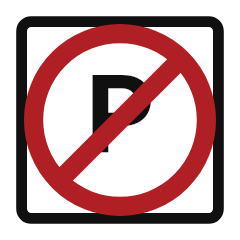
5. Why is this restriction so common beside fire hydrants, crosswalks and intersection corners?
Show answer
Answer C: To keep sight lines open and leave access for emergency crews
A vehicle left in those places hides pedestrians from approaching drivers, blocks the path of turning vehicles and can keep firefighters from reaching a hydrant.
-
6. Which effect appears as a drinker's blood alcohol level climbs well past the first drinks?
Show answer
Answer D: Loss of muscle control and steady steering
Higher levels of alcohol reach the parts of the brain that control movement, which shows up as clumsy steering, late braking and poor lane control.
-
7. At a four-way stop another driver pulls out ahead of you when it was clearly your turn. What is the correct response?
Show answer
Answer B: Let that driver go through, then take your turn when the way is clear again
Right of way is something you give, never something you take, so yielding to a driver who takes it wrongly avoids a crash you would otherwise share.
-
8. At what normal speed must a Montana vehicle display the slow-moving vehicle emblem?
Show answer
Answer D: Less than 25 miles an hour
Montana requires the fluorescent yellow-orange triangular emblem on a vehicle or piece of equipment normally traveling at less than 25 miles an hour.
-
9. What is the minimum Montana liability coverage for bodily injury to or death of one person in any one accident?
Show answer
Answer C: $25,000
Montana law requires a motor vehicle liability policy of at least $25,000 for bodily injury to or death of one person, and $50,000 when two or more people are involved.
-
10. On a Montana two-lane road, what does the law allow while overtaking and passing another vehicle?
Show answer
Answer A: Exceeding the posted limit by up to 10 miles an hour to complete the pass and return to the right lane
The Montana Driver Manual states that vehicles on a two-lane road may exceed the speed limit by 10 miles an hour in order to overtake and pass another vehicle and return safely to the right lane.
-
11. A bicyclist ahead of you puts the left arm straight out to the side. What is being signaled?
Show answer
Answer B: A left turn or a move to the left
The left arm held straight out is the bicycle signal for a left turn, so hold back and give the rider room to cross toward the center.
-
12. What does Montana's basic speed rule require, whatever the posted limit says?
Show answer
Answer A: A careful and prudent speed, reduced to what conditions allow
Montana requires every driver to operate in a careful and prudent manner at a reduced rate of speed no greater than is reasonable and prudent under the conditions that exist.
-
13. How many points does the Montana point schedule assign to a conviction for driving under the influence?
Show answer
Answer C: 10 points
Montana assigns 10 points to driving under the influence, compared with 5 for reckless driving and 3 for speeding.
-
14. A turn restriction sign at the corner shows a range of times below the symbol. What does that mean?
Show answer
Answer A: The turn is banned only during the hours shown on the sign
Times posted under a regulatory symbol set the period during which the restriction applies; outside those hours the movement is permitted.
-
15. You are about to change lanes to the left when you notice a vehicle already overtaking you in that lane. What should you do?
Show answer
Answer A: Hold your lane and your speed, and change only after that vehicle has gone by
A signal asks for space but does not create it, and the overtaking driver has nowhere to go if you move across.
-
16. You feel dizzy and get a headache while driving with the windows closed. What could be the cause and what should you do?
Show answer
Answer D: An exhaust leak letting carbon monoxide into the cabin, so open the windows and stop to get fresh air
Carbon monoxide is colorless and odorless, and headache, dizziness and drowsiness are early signs. Get fresh air at once and have the exhaust system inspected.
-
17. A tractor-trailer is backing slowly across the roadway to enter a loading dock. What should you do?
Show answer
Answer C: Stop and wait until the truck has finished the maneuver
A backing truck driver has a very limited view and the trailer can swing unexpectedly. Trying to squeeze past in either direction risks being crushed.
-
18. What delta-9 tetrahydrocannabinol level in the blood is enough for a Montana driving under the influence charge?
Show answer
Answer A: 5 nanograms per milliliter or more
Montana sets a per se limit of 5 nanograms per milliliter of delta-9 tetrahydrocannabinol in the blood.
-
19. How may a Montana driver show proof of insurance at a traffic stop?
Show answer
Answer C: On a paper card or on an electronic document from the carrier
Montana accepts an insurance card issued by the carrier or an electronic document from the carrier displayed on an electronic device.
-
20. How do worn tires and worn brakes affect your ability to stop?
Show answer
Answer C: They lengthen the stopping distance, especially on a wet road
Worn tread cannot clear water and worn brakes cannot produce full force, so both stretch the distance needed to stop.
-
21. A pedestrian using a white cane or walking with a guide dog starts to cross the street ahead of you. What must you do?
Show answer
Answer A: Yield and stay stopped until the person has finished crossing
A white cane or guide dog identifies a pedestrian who may not be able to see your vehicle, so you must yield and wait rather than maneuver around the person. The horn can confuse the pedestrian or the dog.
-
22. At what tread depth should a tire be replaced?
Show answer
Answer A: When the tread is worn down to 2/32 of an inch
At that depth a tire loses grip quickly, especially on wet roads, and the built in wear bars or the penny test both show when the point has been reached.
-
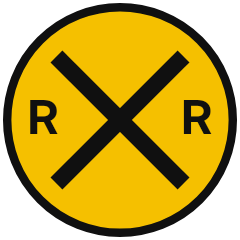
23. A driver sees this sign on a quiet road with no other traffic in either direction. What is the correct response?
Show answer
Answer C: Slow down, look and listen for a train, and be ready to stop
The sign gives advance notice of a highway-rail grade crossing, so the driver reduces speed, checks both directions along the tracks and keeps enough room to stop short of the rails.
-
24. You approach an intersection where the signal is flashing yellow. What should you do?
Show answer
Answer D: Slow down and cross the intersection with caution
A flashing yellow signal warns you to slow down and cross with care; it does not require a stop, but it does not give you priority either.
-
25. You have just passed a large truck on the freeway. Why is it dangerous to pull back in front of it and then brake for your exit?
Show answer
Answer B: A loaded truck needs much more distance to stop than a car
A fully loaded tractor-trailer can need the length of a football field or more to stop from highway speed. Cutting in and braking leaves the driver no room to avoid hitting you.
-
26. Your vehicle is stuck in deep snow and you run the engine for heat while waiting for help. What must you check?
Show answer
Answer C: That the exhaust pipe is clear of snow
Snow packed around the tailpipe pushes exhaust back into the cabin, and carbon monoxide can kill without warning. Clear the pipe and crack a window open.
-
27. How far ahead should you normally be looking while driving?
Show answer
Answer D: About 12 to 15 seconds of travel ahead
Looking that far ahead, roughly a block in town and much farther on a highway, gives you time to see a problem developing and adjust before it becomes an emergency.
-
28. What may a Montana court impose on a third conviction for driving without required insurance?
Show answer
Answer A: A $500 fine, up to 10 days in county jail, or both
Montana allows a $500 fine or up to 10 days in the county jail, or both, on a third or subsequent conviction for operating without insurance.
-
29. A set of reversible express lanes is closed off with gates and signs while it runs the other way. What must you never do?
Show answer
Answer C: Enter past a closed gate or a sign showing the lanes are closed
When reversible lanes are closed they may already be carrying traffic in the opposite direction, so entering past a gate can put you head-on into that traffic.
-
30. What is the safest way to deal with a vehicle sitting in your blind spot?
Show answer
Answer A: Slow a little or move ahead so that it is no longer beside you
You cannot control the other driver, but you can change your own speed so that the vehicle is no longer hidden beside you.
-
31. How close to a fire hydrant may a Montana driver park?
Show answer
Answer C: No closer than 15 feet
Montana prohibits stopping, standing or parking within 15 feet of a fire hydrant, and within 20 feet of a crosswalk at an intersection.
-
32. Who may supervise a Montana learner license holder who is under 18?
Show answer
Answer D: A parent or guardian, or a licensed driver 18 or older with permission
Montana requires the supervising driver to be a parent or legal guardian, or a licensed driver at least 18 years old who has the parent's or guardian's permission.
-
33. A driver ahead brakes for no reason you can see, again and again. What should you do?
Show answer
Answer B: Increase your following distance and be ready for yet another stop
Unexplained braking tells you the driver is unsure or distracted, so the safe answer is more room, not less.