
Montana MVD Motorcycle Practice Test 4
- Questions33
- Correct to pass27
- Passing score82%
- Minimum age16 years
-
1. What does a tire with worn tread do on a wet road?
Show answer
Answer B: It loses grip and it hydroplanes at a lower speed than a good tire
Tread grooves carry water away from the contact patch, and a worn tire cannot do that, so it floats on the water sooner.
-
2. A rider chooses an open face helmet. What does that choice make necessary?
Show answer
Answer A: Separate goggles or a face shield, because the face is uncovered
An open face helmet gives no eye or face protection, so the rider must add goggles or a face shield that will not shatter and that seals against the wind.
-
3. About how far behind a tractor-trailer does the driver's rear blind spot reach?
Show answer
Answer C: Around 30 feet
The area behind a large truck is hidden for roughly 30 feet, so a driver tucked in there cannot be seen at all.
-
4. How long does Montana suspend the license of a driver who refuses a chemical test for the first time?
Show answer
Answer D: 6 months
Montana suspends the driver license for 6 months on a first refusal, and for 1 year on a second or subsequent refusal within five years.
-
5. Is dictating a message by voice a safe alternative to typing one?
Show answer
Answer C: No, it still takes attention from driving
Composing and checking a spoken message loads the mind and usually pulls the eyes to the screen anyway, so research finds it no safer than other phone use.
-
6. Which facility does this sign direct a traveler toward?

Show answer
Answer B: A hospital offering emergency care
This is the standard marker for medical care, used to lead a traveler to a hospital where emergency treatment is available.
-
7. Below a speed limit sign is a smaller panel with white numbers on a black background and the word NIGHT. What does it show?
Show answer
Answer D: The limit that applies after dark
A night speed limit panel sets a separate legal maximum for the hours of darkness, and its reversed colors mark it as the night figure.
-
8. On a narrow two-lane road a line of vehicles has built up behind you. What is the safe and courteous action?
Show answer
Answer D: Pull into a turnout or a safe wide spot and let them go by
A slow vehicle holding up a queue invites risky passing; using a turnout clears the road without anyone having to take a chance.
-
9. The center line beside your lane is solid yellow while the opposite side has a broken yellow line. What does this mean?
Show answer
Answer D: You may not pass, but traffic in the other direction may
A solid yellow line on your side of the center marks a no-passing zone for your direction only, while the broken line grants the opposing direction a passing zone.
-
10. You are traveling in the same direction as a funeral procession and want to get ahead of it. What should you not do?
Show answer
Answer B: Driving in between the vehicles of the procession
Most states prohibit driving into or through a funeral procession, and cutting into the line leaves the drivers behind with no lead vehicle to follow, so go around only where passing is permitted.
-
11. A delivery truck is parked in your lane and you must use the oncoming lane to get around it. Who has the right of way?
Show answer
Answer D: The oncoming traffic, because their lane is clear
The driver whose own lane is obstructed waits, because using the other lane is a favor from oncoming traffic, not a right.
-
12. Which statement about standard drinks is correct?
Show answer
Answer C: A standard serving of beer, of table wine and of distilled spirits each contain about the same amount of pure alcohol
Roughly 12 ounces of regular beer, 5 ounces of table wine and 1.5 ounces of 80 proof spirits each contain about the same amount of pure alcohol, so the type of drink does not change the effect.
-
13. You have stopped at a stop line but parked cars hide the cross street. What comes next?
Show answer
Answer C: Edge forward to where you can see, stopping again if needed
The legal stop at the line is only the first stop; you then move up slowly to a point where you can see, and stop again if traffic requires it.
-
14. Why do experienced riders cover the clutch lever and the brake lever in heavy traffic?
Show answer
Answer B: It shortens the time needed to react if they suddenly have to stop
With fingers already resting on the levers the rider skips the time it takes to reach for them, which shortens overall stopping distance.
-
15. A loaded truck is coming up an entrance ramp as you approach in the right lane of the freeway. What is the most helpful action?
Show answer
Answer A: Adjust your speed to open a gap for it
A heavy vehicle accelerates slowly, so opening a gap or moving over costs you seconds and saves the truck driver from being forced to stop on the ramp.
-
16. You are following a large truck on a two-lane road and cannot see past it. What should you do before deciding to pass?
Show answer
Answer D: Drop back so that your view of the road ahead opens up
Distance is what buys you a view around a large vehicle, and no decision to pass can be made from a position where you cannot see.
-
17. Where is ice most likely to form first on a cold day?
Show answer
Answer B: In shaded areas and on bridges and overpasses
Shaded spots stay cold longer and bridges and overpasses lose heat from below as well as above, so ice appears there before it appears elsewhere.
-
18. You reach the end of the acceleration lane and there is still no gap in the traffic. What should you do?
Show answer
Answer B: Slow down and merge behind the traffic rather than forcing your way in
Merging behind the traffic costs you only a little speed, while forcing into a space that is not there puts you alongside a vehicle with nowhere to go.
-
19. On traffic control devices, the color green shows direction to a destination and also shows
Show answer
Answer C: that a movement is permitted
Green carries two assignments: guidance toward destinations, and the idea that the movement shown is allowed, as on a green arrow.
-
20. When should speed be adjusted for a curve?
Show answer
Answer B: Before entering the curve
Slowing before the curve lets the rider hold a steady or slightly increasing throttle through it, which settles the suspension and keeps traction predictable.
-
21. What is the correct sequence for shifting into a higher gear?
Show answer
Answer C: Roll off the throttle, squeeze the clutch, lift the lever, ease the clutch out
Closing the throttle as the clutch comes in, then easing the clutch out as the throttle is reopened, keeps the change smooth and the chassis settled.
-
22. Under Montana law, how many motorcycles may travel side by side in a single traffic lane?
Show answer
Answer B: No more than two, and only with the consent of both operators
Montana permits no more than two motorcycles to be operated abreast in a single traffic lane, and only with the consent of both drivers.
-
23. How should your speed behave while you move from one lane into the next?
Show answer
Answer C: Keep it steady or adjust it smoothly to match the traffic in the new lane
A lane change works best as a smooth movement at the speed of the lane you are joining, since sudden braking or acceleration surprises the drivers around you.
-
24. You are stopped facing uphill on a steep grade and need to pull away. What is the recommended technique?
Show answer
Answer D: Hold with the rear brake, ease the clutch into the friction zone, then release
The rear brake keeps the motorcycle from rolling backward while the clutch takes up the drive, and it is released as the throttle is opened.
-
25. You must slow down in a curve but there is no room to straighten the motorcycle. What should you do?
Show answer
Answer A: Brake gently at first and reduce the lean angle as your speed comes down
Braking and turning compete for the same traction, so brake pressure has to stay light while lean angle is high and can grow as the machine comes upright.
-
26. You are approaching a driveway where a car waits to pull out and the driver is looking your way. What should you assume?
Show answer
Answer D: The driver may not have seen you, so cover the brakes and be ready to slow
Looking in your direction is not proof that a driver has registered a motorcycle, so cover the brakes and be ready to slow until the car is clearly staying put.
-
27. You are driving along a street lined with parked cars. What should you watch for?
Show answer
Answer B: Doors opening, vehicles pulling out and pedestrians stepping from between cars
Parked cars hide people and can move without warning. Keep as much space from them as you safely can and cover the brake.
-
28. Traffic has built up behind you while you wait for a gap to turn left. How should that affect your decision?
Show answer
Answer C: It should not change it; wait for a gap that is genuinely safe
Pressure from behind does not make a small gap bigger, and rushing a left turn across traffic is a common cause of serious crashes.
-
29. In a work zone a flagger is directing traffic in a way that conflicts with the posted signs. Whom do you follow?
Show answer
Answer B: The flagger's directions
A flagger controls traffic through a work area that changes from day to day, and those instructions take precedence over the fixed signs and markings in that zone.
-
30. You approach a traffic signal that has already been green since it first came into view. What should you expect?
Show answer
Answer B: That it may change at any moment, so be ready to stop
A signal already green when you first see it is well into its cycle, so a rider covers the brakes and plans a stop rather than assuming a clear run.
-
31. How long should a glance at a mirror or an instrument take?
Show answer
Answer A: A brief glance of about a second, returning your eyes to the road at once
Checks should be quick flicks of the eyes. At highway speed, a few seconds with your eyes off the road covers a distance long enough for a hazard to appear.
-
32. What must a driver be prepared to do at the point this sign refers to?
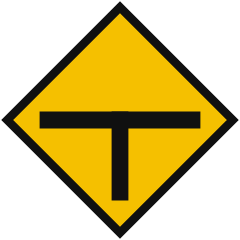
Show answer
Answer D: Turn left or right, because the road being traveled ends there
The road ends at another roadway, so the driver must slow, give way to traffic on the through road and turn in one direction or the other.
-
33. Why do safety agencies put head protection first among riding gear?
Show answer
Answer A: Because head injuries are the leading cause of death in motorcycle crashes
Head injury is the most common cause of death in motorcycle crashes, which is why a certified helmet is the single most important piece of gear.