
Montana MVD Motorcycle Practice Test 3
Test 3 of 6. Pick an answer for each question to see if it is right and why; your score appears at the end. You need 27 correct answers to pass, the same ratio as the real Montana test.
- Questions33
- Correct to pass27
- Passing score82%
- Minimum age16 years
-
1. What is the daytime and nighttime speed limit for cars on Montana interstate highways outside urbanized areas?
Show answer
Answer C: 80 miles an hour
Montana law sets 80 miles an hour at all times for vehicles on interstate highways located outside an urbanized area of 50,000 or more people.
-
2. How does Montana change the fine for a traffic violation committed in a marked work zone?
Show answer
Answer C: It at least doubles the penalty when a worker was within 1,000 feet
Montana at least doubles the penalty for a traffic violation in a marked work zone when a highway worker was present within 1,000 feet of the violation.
-
3. You are turning left into a street that is divided by a raised median. Which side should you enter?
Show answer
Answer C: The right-hand roadway, so that you travel on the proper side
A raised median separates two directions of travel, so the turn must be completed into the roadway carrying traffic your way.
-
4. The rider ahead of you has just passed a slow vehicle on a two lane road. What does that tell you about your own pass?
Show answer
Answer C: Nothing, because you must judge the oncoming traffic yourself
Every pass uses up part of the gap, so the space that was ample for the rider ahead may be far too short by the time it is your turn.
-
5. What is the function of a regulatory sign?
Show answer
Answer A: To inform road users of traffic laws or regulations that apply at that location
Regulatory signs state requirements that carry the force of law where they are posted, so disregarding one is a violation rather than a lapse of judgment.
-
6. Montana allows lane filtering. How fast may the vehicle being overtaken be moving for filtering to be legal?
Show answer
Answer A: It must be stopped or moving at 10 miles an hour or less
Montana defines lane filtering as overtaking a vehicle that is stopped or traveling at 10 miles an hour or less in the same lane and direction.
-
7. Which of these is a known cause of a high speed wobble?
Show answer
Answer C: Incorrect tire pressure or a load carried too far back and too high
Wobble is usually traced to tires, wheels, loading or poorly mounted accessories such as a windshield or fairing, so check pressures and how the machine is loaded.
-
8. What does a tire with worn tread do on a wet road?
Show answer
Answer B: It loses grip and it hydroplanes at a lower speed than a good tire
Tread grooves carry water away from the contact patch, and a worn tire cannot do that, so it floats on the water sooner.
-
9. What should a rider check about the size of a motorcycle before riding it?
Show answer
Answer C: That both feet reach the ground and the controls are within reach
A motorcycle that fits lets the rider put both feet down at a stop and work every control without stretching, and a machine that is too tall or too heavy is hard to hold up in slow traffic.
-
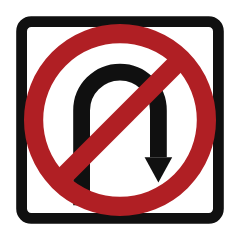
10. A driver who wants to reverse direction arrives at this sign. What is allowed?
Show answer
Answer C: Going on and reversing direction only where the maneuver is permitted
The restriction removes that maneuver at that spot entirely, so the driver has to continue and turn the vehicle around at a place where it is not prohibited.
-
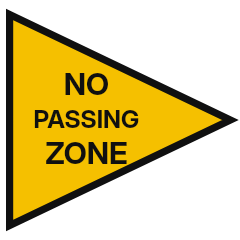
11. A driver is thinking about overtaking a slower vehicle and sees this sign a short distance ahead. What does it mean for that pass?
Show answer
Answer B: The pass must be finished before the restricted section begins
The sign marks the start of a section where passing is prohibited, so a driver may not be on the left side of the road beyond it; any pass has to be completed before that point or not started at all.
-
12. What Montana offense does a driver commit by purposely ignoring or striking traffic control devices in a work zone?
Show answer
Answer D: Reckless endangerment of highway workers
Montana's offense of reckless endangerment of highway workers covers driving in a work zone in a manner that endangers persons or property and purposely removing, ignoring or striking work zone traffic control devices.
-
13. You are riding alongside a car in the next lane at the same speed. What is the problem?
Show answer
Answer B: You may be sitting in the driver's blind spot with nowhere to escape
A driver who cannot see the motorcycle may change lanes into it, so riders adjust speed to move ahead of or behind the vehicle instead of staying beside it.
-
14. How many conviction points within three years make a driver a habitual traffic offender in Montana?
Show answer
Answer D: 30 or more points
Montana defines a habitual traffic offender as a person who accumulates 30 or more conviction points within a three-year period.
-
15. A shared-use path crosses the road ahead at a marked crossing and people are already crossing on it. What should you do?
Show answer
Answer C: Yield and let them finish crossing the road
People already crossing at a marked crossing have the right of way, and a path crossing is a crossing of the roadway like any other.
-
16. Besides law enforcement and emergency vehicles, which stationary vehicle triggers Montana's move over duty?
Show answer
Answer B: A highway worker vehicle using its emergency lights
Montana's move over duty covers a stationary law enforcement or authorized emergency vehicle using its siren or lights and a stationary highway worker vehicle using its emergency lights.
-
17. Another driver cuts you off and you feel your temper rising. What should you do?
Show answer
Answer A: Take a breath, drop back and let it go, because the whole trip matters more
Retaliation turns a moment of bad driving into a crash, and dropping back costs you only a few seconds.
-
18. On a Montana two-lane road, what does the law allow while overtaking and passing another vehicle?
Show answer
Answer A: Exceeding the posted limit by up to 10 miles an hour to complete the pass and return to the right lane
The Montana Driver Manual states that vehicles on a two-lane road may exceed the speed limit by 10 miles an hour in order to overtake and pass another vehicle and return safely to the right lane.
-
19. At a four-way stop another driver pulls out ahead of you when it was clearly your turn. What is the correct response?
Show answer
Answer B: Let that driver go through, then take your turn when the way is clear again
Right of way is something you give, never something you take, so yielding to a driver who takes it wrongly avoids a crash you would otherwise share.
-
20. When a Montana court recommends a probationary license after a second DUI, what must the driver use?
Show answer
Answer D: A vehicle fitted with a working ignition interlock device
For a second or subsequent DUI Montana restricts a probationary licensee to a vehicle equipped with a functioning ignition interlock device, at the driver's own expense.
-
21. Which set of qualities should eye protection for riding have?
Show answer
Answer A: Shatter resistant, free of scratches, and sealed against the wind
Riding eye protection has to survive an impact, let you see clearly and keep the air out, which is why plastic face shields and goggles are used instead of ordinary glasses.
-
22. Which color scheme is standard for the drums and barricades that channel traffic through a work zone?
Show answer
Answer C: Alternating orange and white retroreflective stripes
Drums and barricades carry alternating orange and white retroreflective stripes, and the traffic cones used in the same zones are predominantly orange.
-
23. You come upon a crash that has just happened and decide to help. Where should you stop your vehicle?
Show answer
Answer A: Well beyond the scene, completely off the road, with the hazard lights on
Stopping past the crash and off the pavement keeps you from becoming another victim and leaves the approach clear for emergency vehicles.
-
24. On a Montana two-lane highway where passing is unsafe, when must a slow driver pull into a turnout?
Show answer
Answer A: When four or more vehicles have formed a line behind
Montana requires the driver of a slow-moving vehicle to turn off at the nearest safe turnout or use the shoulder when four or more vehicles are following on a two-lane highway where passing is unsafe.
-
25. A vehicle coming toward you has drifted into your lane. What should you do?
Show answer
Answer D: Slow down, sound the horn, flash your lights and steer to the right if possible
Moving right gives the other driver space to recover and keeps you out of the lane they are most likely to return to. Braking reduces the force of any impact.
-
26. What does Montana impose for throwing a lighted cigarette from a vehicle onto a highway?
Show answer
Answer B: A fine of not more than $500
Montana bars throwing lighted matches, tobacco, cigarettes, cigars or other lighted material onto a road or right-of-way, with a fine of up to $500 on conviction.
-
27. On other Montana public highways that are not interstates, what are the day and night speed limits for cars?
Show answer
Answer A: 70 miles an hour during the day and 65 at night
Montana law sets 70 miles an hour during the daytime and 65 miles an hour during the nighttime on public highways other than interstates.
-
28. How does going a long time without sleep compare with drinking?
Show answer
Answer A: It can impair a driver in much the same way
Long periods awake produce slow reactions, poor judgment and lapses of attention that resemble the effects of alcohol, which is why fatigue counts as impairment.
-
29. You must leave your vehicle beside a narrow rural road at night. What should you do?
Show answer
Answer B: Get it right off the pavement and switch on the hazard lights
A vehicle left on an unlit rural road is very hard to see, so move it completely clear of the traveled surface and mark it with the hazard lights.
-
30. What does Montana's basic speed rule require, whatever the posted limit says?
Show answer
Answer A: A careful and prudent speed, reduced to what conditions allow
Montana requires every driver to operate in a careful and prudent manner at a reduced rate of speed no greater than is reasonable and prudent under the conditions that exist.
-
31. You have had to leave the pavement onto a loose gravel shoulder and now need to stop. How should you brake?
Show answer
Answer D: Use both brakes gently and evenly, expecting a much longer stopping distance
Loose gravel cuts available traction sharply, so apply both brakes lightly and smoothly and allow far more room than you would need on pavement.
-
32. The circular sign shape is reserved for which warning?
Show answer
Answer C: Advance warning of a highway-rail grade crossing
A round yellow sign with a black X and the letters RR is the grade crossing advance warning sign, and the circular outline is used for no other message.
-
33. A driver's blood alcohol concentration is below the legal limit, but the driver is visibly impaired. Can the driver be arrested?
Show answer
Answer C: Yes, driving while impaired by alcohol is an offense at any concentration
The per se figure, 0.08 percent in most states and 0.05 percent in Utah, is the level at which impairment is presumed. Impairment shown by driving behavior and field tests is enough on its own, because alcohol affects skills well before that number.