
Montana MVD Motorcycle Practice Test 1
Test 1 of 6. Pick an answer for each question to see if it is right and why; your score appears at the end. You need 27 correct answers to pass, the same ratio as the real Montana test.
- Questions33
- Correct to pass27
- Passing score82%
- Minimum age16 years
-
1. Under Montana's implied consent law, which samples has a driver already agreed to give?
Show answer
Answer C: Blood, breath or oral fluid, at the officer's direction
A person who operates or is in actual physical control of a vehicle in Montana is considered to have consented to a test of blood, breath or oral fluid.
-
2. A bicycle symbol topped by two chevrons is painted in the middle of a travel lane. What does that marking indicate?
Show answer
Answer D: Bicyclists share the lane with motor vehicles and may ride away from the curb
A shared lane marking shows drivers where bicyclists are likely to ride in a lane used by both bicycles and motor vehicles.
-
3. You are the first to arrive at a crash on a rural road. What should you do first?
Show answer
Answer C: Park well clear of the scene, put on your hazard lights and call for help
Getting trained help on the way and keeping the scene visible does more good than anything an untrained bystander can do.
-
4. Which rough check suggests that a helmet is a novelty shell rather than a certified helmet?
Show answer
Answer C: It weighs about a pound, far less than a certified helmet
A certified helmet weighs roughly three pounds because of its shell and thick liner, while a novelty shell is very light. Weight is only a clue, and the certification label is the real check.
-
5. On a long uphill grade a second lane opens on the right and a sign directs slower traffic into it. You are towing a trailer and holding up a line of vehicles. What should you do?
Show answer
Answer A: Move into the right-hand lane and let the faster traffic use the left lane
A climbing lane exists so that slow vehicles can be passed safely, and the slower vehicle is the one that belongs in it.
-
6. How much room should a rider try to leave when passing a line of parked cars?
Show answer
Answer A: Enough to clear an opening door, roughly the width of a car door
A door swings out about the width of a door, so ride at least that far from parked vehicles and slow down wherever you cannot leave that much space.
-
7. Why is an inexperienced rider a poor choice to lead a group?
Show answer
Answer C: The leader picks the pace, the gaps and the hazards for everyone behind
Every decision the leader makes is imposed on the riders behind, so leading demands more traffic judgment than any other position in the group.
-
8. What driving privilege does Montana allow during a suspension imposed for refusing a chemical test?
Show answer
Answer A: None, because no probationary license may be issued
Montana provides no restricted probationary license during a suspension imposed under the implied consent provisions for refusing a test.
-
9. A face shield keeps fogging up in cool, damp weather. What helps?
Show answer
Answer A: Cracking the shield open slightly, or using an anti fog shield
Fog forms when warm breath meets a cold shield, so moving a little air behind the shield or using an anti fog design is the safe fix.
-
10. How far from a stopped Montana school bus with red lights flashing must an approaching driver stop?
Show answer
Answer C: At least 30 feet
Montana requires a driver meeting or passing a school bus with flashing red lights from either direction to stop at least 30 feet from the bus and to wait until the red lights are turned off.
-
11. A speed limit sign carries a second panel reading TRUCKS 55. What does that panel do?
Show answer
Answer B: It sets a lower legal limit for trucks
A truck speed limit panel is regulatory, so trucks are bound by the lower figure while other traffic keeps to the main limit.
-
12. A police officer is directing traffic at an intersection and waves you through a red light. What should you do?
Show answer
Answer C: Follow the officer, whose directions come before signs and signals
Directions given by a police officer or an authorized flagger override signs, signals and pavement markings.
-
13. What rate does Montana charge for a motorcycle endorsement added to a driver license?
Show answer
Answer B: 50 cents a year or fraction of a year
Montana charges 50 cents a year or fraction of a year for the motorcycle endorsement, on top of the driver license fee.
-
14. A turn restriction sign at the corner shows a range of times below the symbol. What does that mean?
Show answer
Answer A: The turn is banned only during the hours shown on the sign
Times posted under a regulatory symbol set the period during which the restriction applies; outside those hours the movement is permitted.
-
15. What speed must a Montana driver hold when passing a stationary emergency vehicle and no lane change is possible?
Show answer
Answer A: Half of the posted speed limit
A Montana driver who is unable to change lanes must reduce speed to half the posted speed limit while passing the stationary vehicle.
-
16. Montana limits how many people may sit in the front seat of a vehicle other than a bicycle. What is the maximum?
Show answer
Answer B: Three people
Montana prohibits operating a vehicle other than a bicycle with more than three people in the front seat, and separately bars any load or passenger that obstructs the view or interferes with the controls.
-
17. Between which dates does Montana allow studded tires on an ordinary passenger vehicle?
Show answer
Answer C: October 1 and May 31
Montana permits studded tires only between October 1 and May 31, while school buses may use them from August 15 through the following June 15.
-
18. You are approaching an intersection in a line of traffic. What can you do to be more visible to a driver waiting to pull out?
Show answer
Answer D: Move to a lane position where you are not hidden behind the vehicle ahead
A motorcycle tucked directly behind a larger vehicle is invisible to a waiting driver until the moment it appears, so the rider moves to where the headlight can be seen.
-
19. You are approaching a driveway where a car waits to pull out and the driver is looking your way. What should you assume?
Show answer
Answer D: The driver may not have seen you, so cover the brakes and be ready to slow
Looking in your direction is not proof that a driver has registered a motorcycle, so cover the brakes and be ready to slow until the car is clearly staying put.
-
20. Low sun is shining onto the signal ahead and you cannot tell which light is lit. What should you do?
Show answer
Answer D: Slow down and be ready to stop until you can be sure
An unreadable signal has to be treated as one that may be red, so approach slowly enough to stop while you work out what it shows.
-
21. On a Montana four-lane national highway segment of at least 10 miles that is not an interstate, what are the limits?
Show answer
Answer B: 75 by day and 70 at night
Montana sets 75 miles an hour daytime and 70 miles an hour nighttime on a four-lane national highway system segment of 10 miles or more that is not an interstate.
-
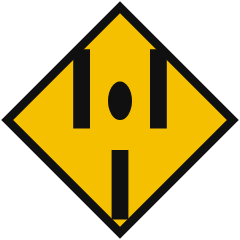
22. What must a driver be ready for beyond this sign?
Show answer
Answer C: Vehicles approaching from the opposite direction in the next lane over
The separation between the two directions runs out, so from that point oncoming vehicles share the same pavement and the driver has to keep right.
-
23. What minimum jail term applies to a second Montana driving under the influence conviction?
Show answer
Answer B: 7 days
Montana sets 7 days to 1 year of imprisonment and a fine of $1,200 to $2,000 for a second DUI conviction.
-
24. What does the solid white line running along the right side of a highway mark?
Show answer
Answer A: The right edge of the traveled way
A solid white edge line shows where the traveled way ends on the right, which is particularly useful at night and in poor visibility.
-
25. Which Montana drivers must stop at every railroad grade crossing?
Show answer
Answer A: School buses and vehicles carrying explosives or flammables
Montana requires a stop at all railroad grade crossings from vehicles carrying seven or more passengers for hire, school buses, and vehicles carrying explosive substances or flammable liquids.
-
26. On a Montana state highway or county road, how much must a driver who can change lanes slow for a stationary emergency vehicle?
Show answer
Answer C: 30 miles an hour below the posted limit
Montana requires a reduction of 30 miles an hour below the posted limit on state highways and county roads, against 20 below on an interstate.
-
27. You are waiting to turn left and an oncoming vehicle stopped in the near lane to turn left blocks your view of the far lane. What should you do?
Show answer
Answer A: Wait where you are until you can see that the far lane is completely clear
The lane you cannot see is where the crash comes from, so you hold your position until the view opens up.
-
28. You and a driver coming from the opposite direction reach a four-way stop at the same time and you are both going straight ahead. What happens next?
Show answer
Answer D: Both of you may move off together, because your paths do not cross each other
Opposing vehicles that are both going straight do not cross paths, so they can move off together once the intersection is clear.
-
29. What does a sign reading Slower Traffic Keep Right require?
Show answer
Answer C: Traffic moving slower than the general flow must use the right-hand lane
The sign applies to any vehicle traveling below the speed of the traffic around it, which must keep right so faster vehicles can use the lanes to the left.
-
30. How many points does Montana add to a driving record for a reckless driving conviction?
Show answer
Answer A: 5 points
Montana's point schedule assigns 5 points to reckless driving, the same value it gives to drag racing and to a liability insurance violation.
-
31. You are starting from a stop on a snowy, icy street and the drive wheels begin to spin. What should you do?
Show answer
Answer C: Ease off the accelerator and start again more gently
Spinning tires polish the surface and dig in. Very gentle pressure on the accelerator, and a higher gear if you have one, gives the tires the best chance to grip.
-
32. Your vehicle breaks down on a busy highway. What is the safest course of action?
Show answer
Answer D: Get it as far off the roadway as possible, switch on the hazard lights and keep clear of the traffic lanes
A vehicle left in or beside a travel lane is a hazard, so move it well off the road, make it conspicuous with hazard lights and keep yourself away from passing traffic.
-
33. The sign over the leftmost lane reads LEFT LANE MUST TURN LEFT. You are in that lane and want to go straight. What should you do?
Show answer
Answer C: Move out of the lane before the intersection if it is safe
A mandatory movement lane control sign makes the turn compulsory for that lane, so a driver who wants another movement must change lanes in advance.